Projects
Independence statement
Every project, publication, document, drawing, image, dataset and result presented anywhere on this website was produced by me independently — or, where an item is explicitly labelled as a team project, together with the co-authors named on it — in a strictly personal or academic capacity, outside any employment relationship, using exclusively my own time, my own equipment and publicly available or academic resources.
None of this material is connected to, derived from, carried out for, commissioned by, funded by, or in any way associated with Dallara or Automobili Lamborghini, or with any other past, present or future employer, client or partner of mine. No confidential, proprietary or commercially sensitive information belonging to any such organisation appears on this website in any form, whether direct, partial, paraphrased or inferable.
Where an organisation is named, it is named solely as a factual statement of my professional background. Nothing here is published on behalf of any organisation, and nothing here should be read as representing, endorsed by, approved by or attributable to any organisation. All opinions expressed are exclusively my own.
I take confidentiality obligations seriously and deliberately exclude from this website any work covered by them. If any organisation nevertheless believes that an item published here touches upon its rights or its confidential information, please contact me at dejanbekic003@proton.me and I will review it and, where appropriate, remove it promptly.
-
BSc thesis · sole author 2026
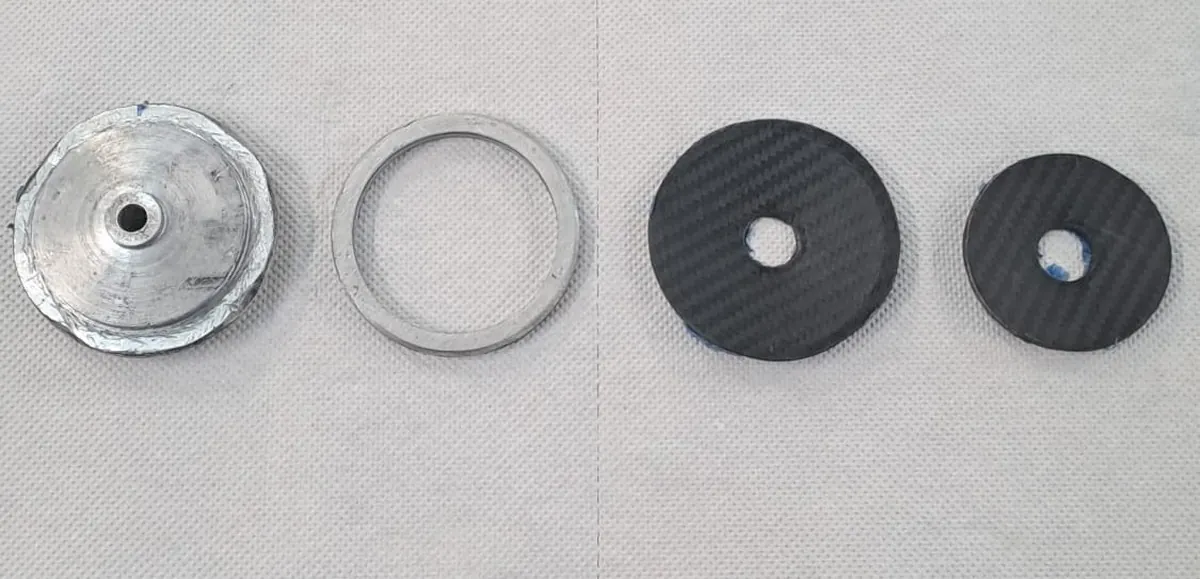
A CFRP Belleville spring for a competition solar EV
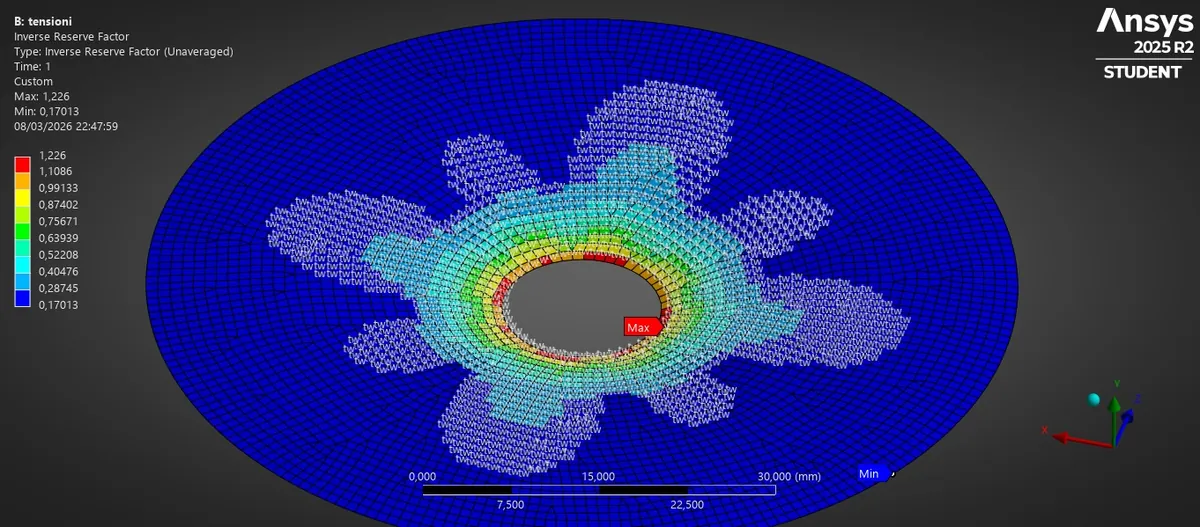
3.94 Hzride frequency, 4.0 target−0.6%FEM vs analytical, flatten0.27mean Tsai–Wu IRFA 700 kg solar vehicle with 20 mm of suspension travel, where a helical coil pushes lateral load into the damper seals every time it compresses. I designed a carbon-fibre disc spring instead: sizing through a parametric MATLAB tool, verification with a ply-by-ply ANSYS model, drawings issued to tolerance, and discs laminated and cured in-house from moulds machined to those drawings.
The interesting outcome was a disagreement. The closed-form model ran 25 to 42% high at mid-deflection while matching to −0.6% at full flatten — a bias I traced to its isotropic-equivalent modulus and rigid-section assumptions. The design margin was re-anchored to the FEM curve rather than to the analytical envelope, and the inner-edge stress peak was resolved as a boundary condition singularity rather than absorbed into a safety factor.
-
University project · three-author team 2025
A CFRP monocoque fairing for a multirotor UAV
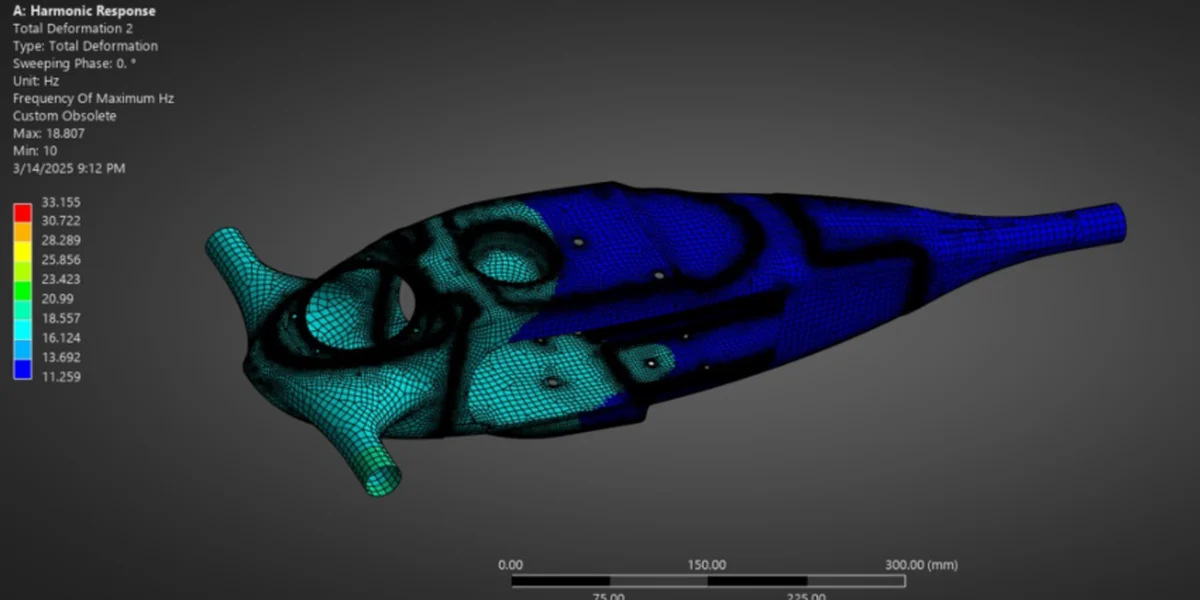
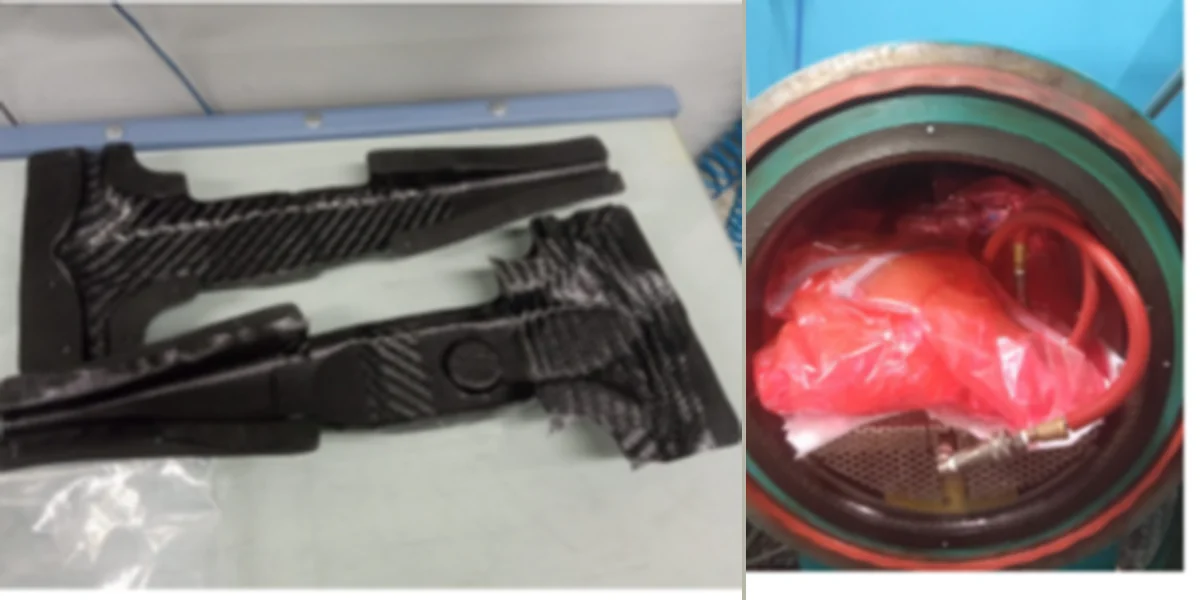
477 gfinal mass, 480 g budget×3.6harmonic vs impact peak stress0.72–2.61 mmbase skin to reinforced stackThe primary structural shell of a small multirotor UAV: it carries three motor booms, the battery pack and two aerodynamic surfaces, and has to survive a 35 g survival impact and a 10–600 Hz vibration environment under 480 g. The work ran top-down from those numbers — load cases first, then a quasi-isotropic equivalent model to size wall thickness cheaply, then a ply-by-ply ANSYS ACP model to verify the laminate — and finished with the part actually laid up by hand, vacuum-bagged and cured in autoclave in-house.
Two things decided the design. First, the two load cases were not close: the harmonic envelope peaks at 1813.5 MPa against 503.24 MPa for the impact, so the layup was anchored to the vibration case and the impact treated as a secondary check. Second, reinforcement was treated as a map rather than a thickness — a [0/45/0]Tw200 skin everywhere, Tw 630 plies at 0° only where the FEM flagged utilisation, with staggered ply drops. The remaining IRF peak of 1.31 sits in a single band at a restrained edge and was resolved as a boundary-condition concentration, not absorbed into a margin. Mesh independence was established first, by sweeping element size, growth rate and curvature normal angle and settling on the plateau.